
Understanding the Kenya safari booking process before you send your first enquiry removes almost all the friction from working with a new ground partner, because you know exactly what happens at each step and what is expected of you. Most agents hesitate over a new destination management company not because they doubt the safari, but because they cannot see how the mechanics work: how fast a quote comes back, when a deposit is due, whose brand is on the itinerary and what happens if a client changes their mind. This article answers all of that in advance. Once you see how a DMC booking works end to end, working with a new ground partner stops feeling like a leap of faith.
Written for travel agents and tour operators, this is a plain walk through of the Kenya safari booking process from the first enquiry to the final invoice, the way Safari Update Travels runs it. It covers each stage, the timelines you can expect, the deposit and payment terms, how white label itineraries keep the client yours and the common questions agents ask before committing. The point is transparency: when you can see the whole process, trusting a ground partner with a client becomes an easy decision.
Key Takeaways
• The process has six clear stages. Enquiry, quote, revision, confirmation and deposit, pre departure and final invoice, each with a defined hand off.
• Quotes come back fast. A well run ground handler returns a costed Kenya safari itinerary within about one working day of a complete enquiry. That is the kind of net rate quote turnaround agents can count on.
• You keep the client relationship. White label itineraries carry your brand, so the client experiences your agency throughout.
• Net rates mean you set the price. You receive supplier level pricing and apply your own markup before the client ever sees a figure.
• Deposits secure the booking; balances fall due before travel. Typical terms are a deposit to confirm and the balance ahead of arrival. Confirm exact safari deposit terms in your trade agreement.
• Registering as a trade partner is quick. Trade partner onboarding needs only your company details and the Kenya products you sell, with no minimum volume.
What Is the Kenya Safari Booking Process, Step by Step?
The Kenya safari booking process is the sequence that turns a client enquiry into a confirmed, paid trip and with a ground handler it runs in six stages: enquiry, quote, revision, confirmation and deposit, pre departure and final invoice. Each stage has a clear owner and a clear hand off, so at any moment you know whose action is next. You manage the client; the ground handler manages the operation and the costing.
Seen as a whole, the process is designed so you spend your time selling and advising, not operating. You send what your client wants, you receive a costed itinerary to mark up and present and once the client says yes, the ground handler runs everything on the ground. The sections below take each stage in turn.
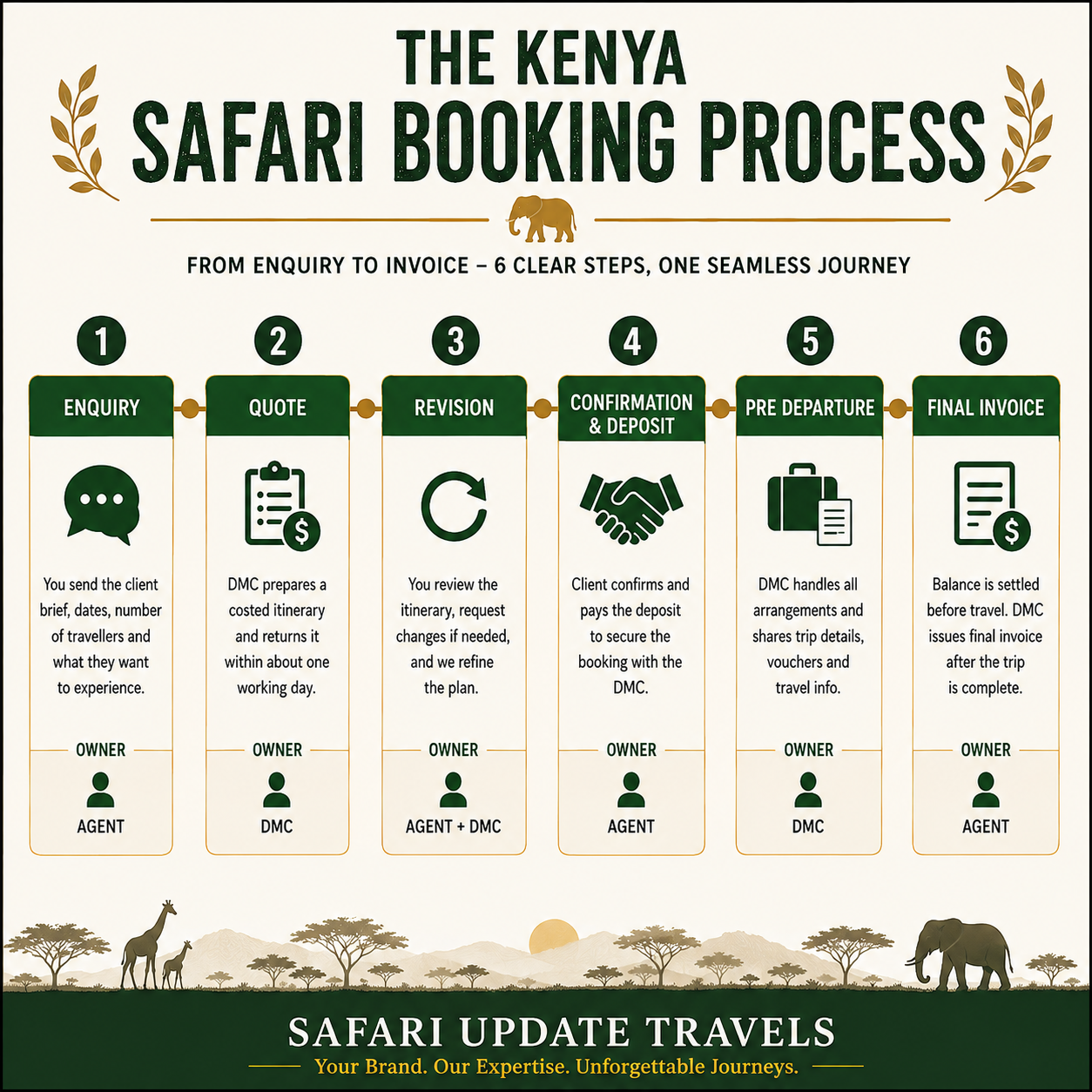
Stage 1: The Enquiry
Everything starts with your enquiry and the more complete it is, the faster and more accurate the quote comes back. A strong enquiry gives the ground handler what it needs in one message: travel dates or a rough window, number of travellers and their ages, the accommodation tier the client wants, any must see parks or experiences and the client’s home market. You do not need a finished itinerary; you need enough for the ground handler to build one.
This is also where a good partner adds value early. If your requested routing wastes a day on the road, or the dates cross a park fee boundary, or the tier does not match the budget, the ground handler should flag it in the response rather than silently quoting something suboptimal. Think of Stage 1 as a short briefing, not a form. For how the underlying costs are built, see how to price a Kenya safari for your clients. Handled well, this is the moment the safari enquiry to booking journey starts moving in your favour.
Stage 2: The Quote
Once the enquiry is complete, the ground handler returns a costed Kenya safari itinerary and quote turnaround is one of the clearest signals of a reliable partner. A ground handler that prices Kenya every day can usually turn a complete enquiry around within about one working day, which matters because clients often approach several agents at once and the first solid, well explained quote frequently wins.
The quote you receive is on net rates: a supplier level price that you mark up yourself before presenting to the client. That keeps pricing control with you and protects your margin, rather than handing you a fixed retail figure. A clear quote also separates what is included from what is not, so you can set client expectations precisely and avoid disputes later.
Expert Insight: The enquiries that get same day quotes are the complete ones. When an agent sends dates, party size and ages, tier and parks in a single message, we can cost it immediately; when those arrive in pieces over three days, the quote takes three days. A two minute complete brief is the fastest thing an agent can do to win a time sensitive client.
Stage 3: Revisions
Very few trips are booked off the first quote and a good Kenya safari booking process expects revisions rather than resisting them. This is where you and the ground handler tune the itinerary to the client: dropping a tier to meet a budget, swapping a road transfer for a flight to save a day, adding a night in the Mara, or adjusting for a client who wants fewer early starts.
The key metric here is responsiveness. Each revision should come back quickly and cleanly, with the price impact of every change shown, so you can guide the client’s decision in real time while their interest is high. A partner who takes days to reprice a single swap will cost you bookings; a partner who turns revisions around fast helps you close. Keep revisions flowing through one contact so nothing gets lost.
Stage 4: Confirmation and Deposit
When the client says yes, the booking moves from provisional to confirmed and this is the stage governed by deposit and payment terms. Typically a deposit confirms the booking and secures the lodges and internal flights, with the balance due before travel. Exact figures vary by operator and by how close the booking is to departure, so the precise deposit percentage and balance deadline should be set out in your trade agreement. Confirm current deposit and payment terms with the ground handler before you commit a client.
Confirmation is also where the ground handler locks in the moving parts: rooms are held, flights are booked and the transfer plan is set. From this point the client has a secured trip and you have a clear schedule of what is paid and what remains. Getting the terms in writing at this stage is what prevents awkward conversations later, so treat the trade agreement as the reference document for the whole relationship.

Stage 5: Pre departure
With the booking confirmed and paid down, the pre departure stage is about getting the client ready and keeping your brand front and centre. The ground handler prepares the client facing documents and a strong partner delivers these as white label itineraries carrying your agency’s brand, not theirs, so the client experiences your business throughout. This is what keeps the relationship, the credit and the repeat booking yours.
Pre departure is also when the client’s readiness gets checked: the eTA obtained, the passport verified, the arrival and transfer plan confirmed in writing. A ground handler that briefs the client on entry requirements and confirms exactly who meets them at the airport removes the most common first timer anxieties. Hand your client our Kenya entry requirements checklist so nothing is missed. The reassurance a smooth pre departure creates is a large part of why clients rebook.
Stage 6: The Final Invoice and After
The final invoice closes the commercial loop, reconciling the confirmed itinerary, any late changes and the balance so both sides have a clean record. Because you booked on net rates, your margin is already built into the price the client paid you and the invoice from the ground handler reflects the net cost, not the client facing figure. One enquiry, one costed itinerary, one clean invoice: that is the administrative appeal of running a Kenya safari through a single ground partner.
The relationship should not end at the invoice. A good ground handler shares post trip feedback and helps you capture the repeat business that Kenya reliably generates, since safari clients often return for another African trip. For the bigger picture on why this partner choice matters so much, see why your Kenya ground handler matters more than your itinerary.
How to Register as a Trade Partner
Starting the Kenya safari booking process for the first time takes only a short onboarding step. To register as a trade partner with Safari Update Travels, send your company name, website and the type of Kenya products you sell, whether FIT safaris, group tours or corporate travel, to partner@safariupdatestravel.com. You receive your trade rates and a dedicated contact in return and there is no minimum volume required to begin.
From there the process is exactly as described above: enquiry, quote, revision, confirmation and deposit, pre departure and invoice. Once you have run one booking end to end, the mechanics become routine and Kenya becomes a product you can sell as confidently as any in your portfolio.
Frequently Asked Questions
How long does it take to get a Kenya safari quote?
A ground handler that prices Kenya daily can usually return a costed itinerary within about one working day of receiving a complete enquiry. The speed depends heavily on how complete your enquiry is: dates, party size and ages, tier and parks in one message allow an immediate quote. Fast turnaround matters because clients often contact several agents at once. That kind of net rate quote turnaround is what lets you respond to a client before a competing agent does.
What information does a ground handler need to quote a Kenya safari?
Provide the travel dates or window, the number of travellers and their ages, the accommodation tier the client wants, any must see parks or experiences and the client’s home market. That is enough to build and cost an itinerary; you do not need a finished plan. A good partner will also flag any issues with your routing or dates in the response. Send that much and the safari enquiry to booking journey can move forward the same day.
What are typical deposit and payment terms for a Kenya safari?
Typically a deposit confirms the booking and secures lodges and internal flights, with the balance due before travel, though exact figures vary by operator and by how close the booking is to departure. The precise safari deposit terms, including the deposit percentage and balance deadline, should be set out in your trade agreement. Always confirm current terms in writing before committing a client.
Will the client see the ground handler’s brand or mine?
With white label itineraries, the client facing documents carry your agency’s brand rather than the ground handler’s, so the client experiences your business throughout. The ground handler operates behind the scenes while you keep the relationship, the credit and the repeat booking. Confirm that a partner offers white label documents before you start.
How do net rates work in the booking process?
You receive a net, supplier level price from the ground handler and apply your own markup before presenting a figure to the client, so you control the client facing price and keep the margin. The final invoice from the ground handler reflects the net cost, not what the client paid you. This is what makes selling a Kenya safari through a DMC commercially attractive. Once you have seen how a DMC booking works from quote to invoice, pricing every future safari becomes second nature.
How do I become a trade partner and is there a minimum volume?
Trade partner onboarding is quick: send your company name, website and the Kenya products you sell to partner@safariupdatestravel.com or register directly at partner page and you receive your trade rates and a dedicated contact. There is no minimum volume required to begin, so you can start with a single booking. Better commercial terms often unlock as your volume grows.
Transparency Builds the First Booking
The Kenya safari booking process is not complicated once it is laid out: six clear stages, fast quotes, net rates you mark up, white label documents that keep the client yours and clean terms set in writing. Seeing the whole path from enquiry to invoice is what makes trusting a new ground partner easy, which is exactly why we set it out plainly. When the mechanics are transparent, the only thing left to do is send the first enquiry.
Ready to run your first booking? Register as a trade partner now and send us an enquiry.
Written by Linsel Ajode, Senior Safari Specialist at Safari Update Travels. Safari Update Travels is a Kenya based, TRA-registered safari operator and ground handler, serving international travel agents and tour operators since 2016 and rated 4.8 stars on TripAdvisor, Trustpilot and SafariBookings.