Kenya vs Tanzania Safari: Which Should You Sell First?
The Kenya vs Tanzania safari question is one every agent adding East Africa has to answer. The honest answer is that Kenya is usually the smarter product to sell first. It is easier to reach, easier to combine, gentler on a first time safari client and simpler to run. That means fewer things go wrong on your first bookings in the region. Tanzania is spectacular and belongs in your portfolio. But as a starting product it brings more moving parts and higher entry costs, just when you are still learning the market.
This guide looks at the Kenya vs Tanzania safari question from the agent's side. It is for the person choosing what to build and promote, not the tourist choosing a holiday. It covers access and flights, cost, Great Migration timing, terrain and game density and the combined country option. Then it gives a clear view on which to sell first and why. Whichever way you lean, knowing both makes you a more trusted seller of a Kenya safari and of East Africa as a whole.
Key Takeaways
• Kenya is the easier first sell. In most Kenya vs Tanzania safari choices, Nairobi's quick light aircraft hops to the parks win. A Kenya safari has less transfer friction than Tanzania's northern circuit.
• Tanzania often costs more to enter. Park fees, nightly concession fees, crater fees and internal flights usually push a similar Tanzania trip above a Kenya one.
• The Great Migration is in both countries at different times. It follows a year round loop across the Serengeti and the Masai Mara. So "the migration" is not a reason to pick one country without checking the month.
• Kenya suits first timers and families; Tanzania rewards the second trip. Kenya's private conservancies and shorter drives make an easier first safari. Tanzania's scale suits clients who already know they love safari.
• Combining both is a premium upsell, not a beginner trip. A combined Kenya and Tanzania safari works well with enough days and budget. It is not the trip to sell a client with ten days and a tight budget.
• Your ground handler decides how smoothly either runs. The country matters less than the operator holding the logistics together on the ground.
Kenya or Tanzania Safari: Which Should a Travel Agent Sell First?
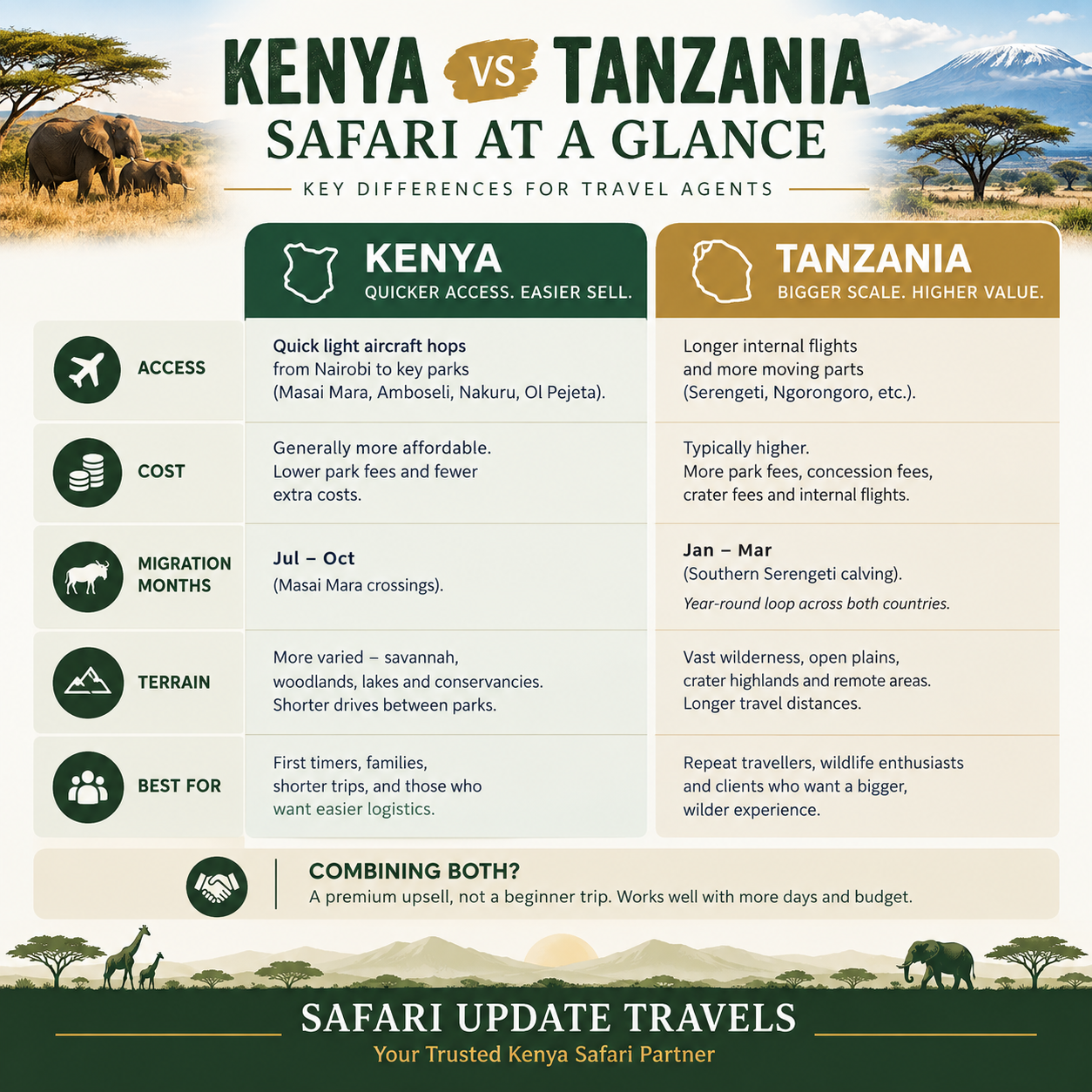
For most agents building an East Africa product, Kenya is the best East Africa safari to sell first. It converts more easily and is more forgiving while you learn. A Kenya safari gives clients quick access from Nairobi to the Masai Mara, Amboseli, Lake Nakuru and Ol Pejeta. It also offers strong family and first timer options. A wide choice of private conservancies softens peak season crowds.
Tanzania adds the Serengeti, the Ngorongoro Crater and vast wilderness. But it comes with longer internal flights, higher fees and more moving parts. So when a client asks you to choose a Kenya or Tanzania safari for a first trip, Kenya is usually the safer answer.
That does not mean Kenya beats Tanzania on every measure. It means Kenya is the lower risk entry product that converts better. Get a reliable Kenya ground handler and a few smooth departures behind you first. Then adding Tanzania (or a combined trip) is a natural upsell. Sell the product that is easiest to get right first, then grow.
Access and Logistics
Access is where Kenya's lead in the Kenya vs Tanzania safari comparison is clearest. It is also what quietly shapes client satisfaction. Nairobi's Jomo Kenyatta International Airport is one of Africa's best connected hubs. It has frequent long haul service from the UK, Europe, the Gulf and beyond.
From there, a short domestic hop from Wilson Airport puts clients on a Mara airstrip in about 45 minutes to an hour. That means a client can land in the morning and be on a game drive the same afternoon.
Tanzania's northern circuit is reached through Kilimanjaro Airport near Arusha. It has fewer direct long haul options. So clients often route through Nairobi or a Gulf hub and add a connecting flight anyway. Bush flights into the Serengeti can involve several legs and airstrips, which adds time and cost. None of this makes Tanzania hard. But it does make it fiddlier to schedule and easier to get wrong on an early booking.
Expert Insight: Many agents new to East Africa assume they must fly clients into Tanzania for a Serengeti trip. But flying into Nairobi and connecting to Arusha is often shorter and better connected than routing through Dar es Salaam. When we build combined trips, Nairobi is often the smarter gateway, even when the safari's centre of gravity is Tanzania. One catch: clients arriving in Tanzania from Kenya need a yellow fever certificate, so put it on the checklist from day one.
Kenya vs Tanzania Safari Cost Comparison
On a like for like basis, a Tanzania northern circuit safari usually costs more than a similar Kenya safari. Higher park and concession fees and more internal flights drive most of the gap. That gap matters most on your first bookings. Clients are testing a new destination and a new agent at the same time. A lower entry price reduces friction.
Kenya is not automatically cheap. The Masai Mara reserve fee rises to USD 200 per non resident adult per day from July to December 2026. That is one of the highest single park fees in the region. In those months the Mara fee alone can match Serengeti entry. Tanzania's extra cost comes mostly from nightly concession fees, the Ngorongoro Crater vehicle fee and extra flights.
Kenya also gives you more ways to manage cost. You get a wide spread of lodge tiers, private conservancies whose fees are bundled into lodge rates and short flights that keep transport predictable. For how these parts build into a quote, see our guide on how to price a Kenya safari for your clients.
Factor | Kenya | Tanzania (northern circuit) |
|---|---|---|
Main gateway | Nairobi (JKIA), very well connected | Kilimanjaro (Arusha), fewer direct long haul options |
Transfer to first camp | Short light aircraft hop from Wilson | Often several bush flight legs |
Signature fee pressure | Masai Mara peak fee (high) | Park, concession and crater fees (often higher overall) |
Migration presence | Masai Mara, roughly July to October | Serengeti, roughly November to June (varies) |
Best first sell fit | First timers, families, tighter budgets | Second trip clients, wilderness seekers |
Fee and seasonal details are indicative for 2026. Confirm current figures with the Kenya Wildlife Service, the Narok County Government for the Masai Mara, Tanzania National Parks and the Ngorongoro Conservation Area Authority before quoting.
The Great Migration: Timing Beats Country
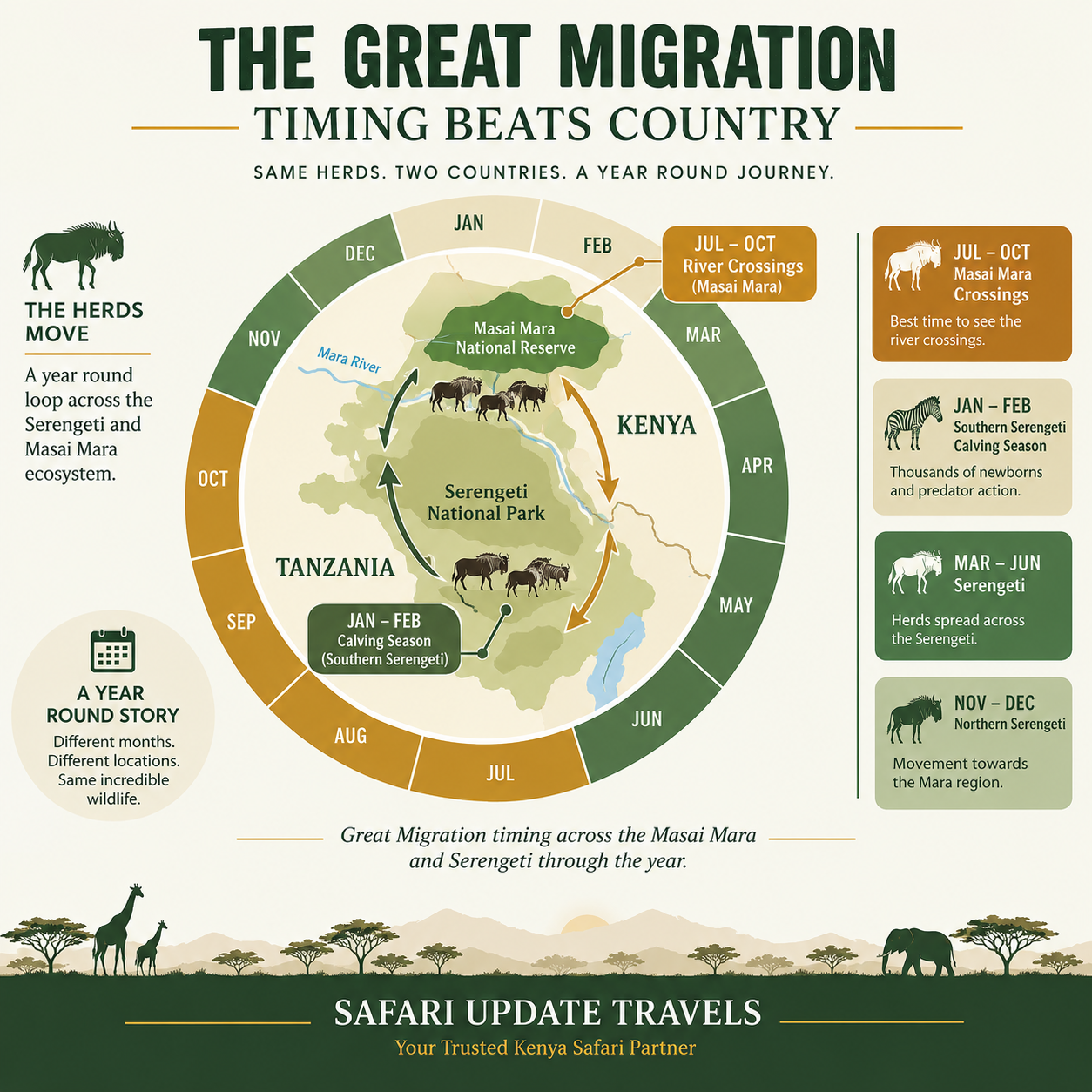
The Great Migration is the most misunderstood point in any Kenya vs Tanzania safari talk. Clients treat it as a reason to pick a country. In truth it is a reason to pick a month. The migration is a year round loop of wildebeest and zebra across the Serengeti and Masai Mara ecosystem. It does not live in one country.
Broadly, the herds spend much of the year in Tanzania's Serengeti. This includes the dramatic calving season around January and February in the southern Serengeti. They cross into Kenya's Masai Mara for the famous river crossings from roughly July to October. So if a client's fixed travel window is August, Kenya is the migration answer. If it is February, Tanzania is.
Great Migration timing decides the sale: sell the calendar first and the country second. Even outside migration months, both countries deliver excellent resident game. A client travelling in April, say, is not missing out by choosing Kenya. This is useful to tell a client who is anxious about "missing the migration": strong sightings do not depend on it.
Terrain, Game Density and Client Experience
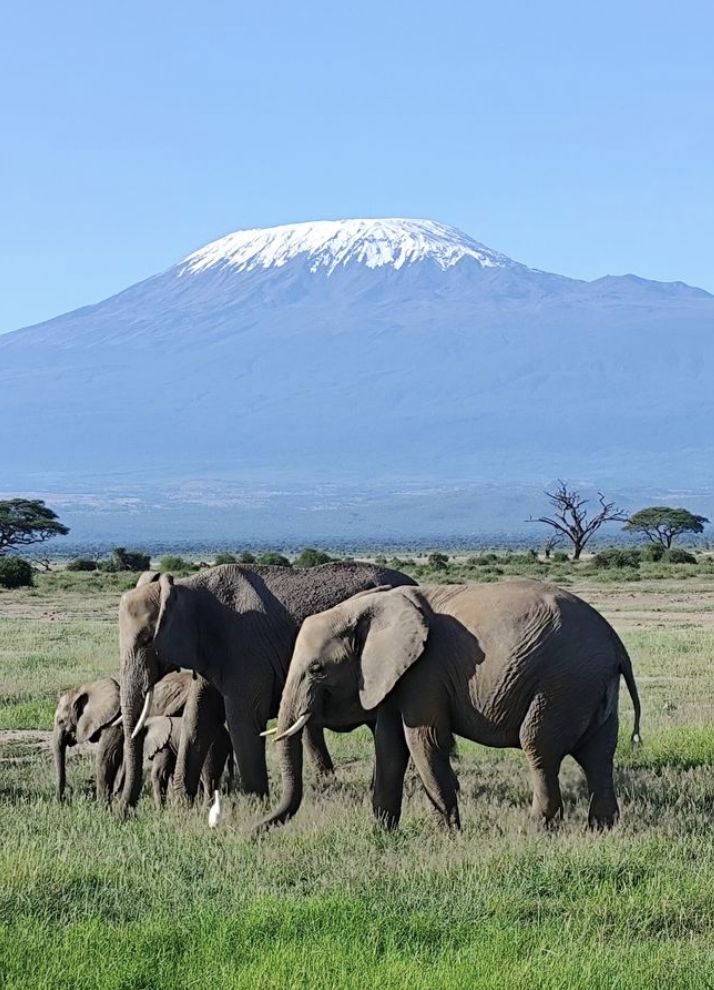
Terrain is where a Kenya vs Tanzania safari feels most different to the client. Matching the land to the client is part of selling well. Kenya packs a lot of variety into short distances. Think of the open plains of the Masai Mara and elephants against Kilimanjaro in Amboseli. Add flamingos and rhino at Lake Nakuru and the dry north of Samburu, often within a few hours of each other.
This variety makes for a rich, comfortable first safari. So do the private conservancies, which limit vehicle numbers and allow off road and night drives.
Tanzania trades that compactness for sheer scale. The Serengeti vs Masai Mara contrast shows it best. The Serengeti is vast and can involve long drives between sightings. The Ngorongoro Crater is a unique enclosed ecosystem that many travellers rate as a highlight. Clients who already love safari, or who want the feeling of endless wilderness, often prefer it. The trade off is more time in a vehicle. For some, the animals also feel less new after a Kenya trip.
A practical selling note from experienced travellers: Kenya's conservancies are a strong answer to the high season crowds clients worry about. They cap vehicles at sightings in a way the main reserves cannot. If a client's fear is "too many other jeeps," a Kenya conservancy is often a better sell than either main park.
When to Sell a Combined Kenya and Tanzania Safari
This is where the Kenya vs Tanzania safari question becomes "why not both?" A combined Kenya and Tanzania safari is a wonderful trip with strong margins. But it is an upsell for the right client, not a default. It works when the client has both the days and the budget. As a rule of thumb, under ten or twelve days makes a two country trip feel rushed. It also gets heavy on transfers. Fourteen days lets it flow.
The smoothest combined trips use inter camp flights to avoid long border drives. They often route through Nairobi in both directions. A typical shape is a few nights in the Masai Mara and a few in the Serengeti. Then comes a descent into the Ngorongoro Crater and a flight back to Nairobi for the flight home. You can see sample routings on our Kenya and Tanzania safaris page.
Sell this as the premium East Africa trip for clients who want to see the whole ecosystem. Keep the single country Kenya safari as your easy entry product. For a client with limited time or budget who still wants everything, resist the two country trip. Deepen the Kenya itinerary instead, because a well run single country safari beats a rushed two country one every time.
Frequently Asked Questions
What entry documents does a combined Kenya and Tanzania safari need?
Every Kenya vs Tanzania safari that crosses the border needs two separate entry permissions. Clients need a Kenya eTA and a Tanzania tourist visa from the Tanzania Immigration Services portal. The East Africa Tourist Visa does not cover Tanzania. The good news: the Kenya eTA stays valid when clients come back into Kenya from Tanzania. So clients flying home through Nairobi do not need a second one. See our visa requirements page for the Kenya side.
Do clients need a yellow fever certificate for a Kenya and Tanzania trip?
Yes, in most combined trips. Tanzania asks for proof of yellow fever vaccination from travellers arriving from countries with yellow fever risk. Kenya is on that list. A client who does Kenya first and then enters Tanzania should carry a valid yellow card. Sources differ on short airport transits, so treat the certificate as essential on any Nairobi routing. Advise clients to see a travel clinic well before departure.
Do clients need travel insurance for Kenya or Tanzania?
Kenya has published a mandatory travel health insurance rule for visitors staying less than 12 months. It sets a minimum total cover of USD 50,000. The option is not mandatory on application, confirm from Kenya eTA portal earlier before date of departure. Home country policies are accepted if they meet the set limits. Zanzibar has had its own mandatory insurance for visitors since October 2024. Confirm the latest rules for both before every departure.
Can a safari vehicle drive straight from the Masai Mara into the Serengeti?
No. There is no direct tourist crossing between the two parks. Road trips go round through border posts such as Isebania or Namanga. Kenyan registered safari vehicles and guides cannot operate inside Tanzanian parks. The same applies the other way. Clients change vehicle and guide at the border. That is why most combined trips fly between the two countries.
Serengeti vs Masai Mara: where are the best river crossings?
The Mara River runs through both parks. So river crossings happen in the northern Serengeti as well as in the Masai Mara, broadly from July to October. The Mara is closer to Nairobi and easier to reach on a short trip. The northern Serengeti is more remote and often quieter, but it needs longer flights. Exact Great Migration timing shifts each year with the rains, so avoid promising a crossing on a set date.
Is Zanzibar or the Kenya coast better for a beach extension?
Both work well. The right one follows the safari. The Kenya coast pairs naturally with a Kenya safari, with short flights and no second visa. Our Amboseli, Tsavo and Mombasa/Diani itinerary shows the shape. Zanzibar pairs best with Tanzania. It needs the Tanzania visa plus Zanzibar's own mandatory travel insurance.
What is the best East Africa safari to sell to families?
For most families, Kenya. Parks sit closer together, so children spend less time in vehicles and more time watching wildlife. Check each lodge's age policy before quoting, because many camps set minimum ages for game drives or tents. Children also pay lower park fees in both countries, which helps a family budget.
The Kenya vs Tanzania Safari Verdict for Selling Agents
In the Kenya vs Tanzania safari decision, sell Kenya first. It gives you the smoothest logistics, the widest range of price points and the gentlest learning curve for your first bookings. It still delivers a world class safari that earns referrals. Keep Tanzania and the combined two country trip as premium upsells for clients with the time, budget and appetite for more.
The country you lead with matters. But the ground partner you build on matters more. That is what turns a good Kenya safari itinerary into a trip your clients rave about.
Partner with Safari Update Travels as your Kenya ground handler and build East Africa the low risk way. Register as a trade partner or email partner@safariupdatestravel.com.
Written by Linsel Ajode, Senior Safari Specialist at Safari Update Travels. Safari Update Travels is a Kenya based, TRA registered safari operator and ground handler, serving international travel agents and tour operators since 2016 and rated 4.8 stars on TripAdvisor, Trustpilot and SafariBookings.