Kenya Entry Requirements: What Clients Need Before JKIA
Knowing the Kenya entry requirements is part of your job as the agent managing the booking. When a client is turned away at check in or held up at Jomo Kenyatta International Airport, they call you, not the airline. The good news is that Kenya's entry process is simple once you know the pieces. Every one of them can be sorted well before departure.
The risk is not that the rules are hard. It is that a client misses a step because nobody told them clearly. This guide sets out the Kenya entry requirements in the order you should check them.
This checklist is written for travel agents and tour operators so you can brief clients confidently and head off the problems that cause airport stress. It covers the Kenya eTA (the Kenya electronic travel authorization that replaced the old visa), passport and yellow fever rules, the JKIA arrival process, connectivity, transfers and the mistakes that catch travellers out. Treat it as a Kenya travel documents checklist you can adapt for every Kenya safari client you send. Entry rules change, so confirm every regulated detail below on the official Kenyan government portals at the time of booking.
Key Takeaways
• Most visitors need a Kenya eTA before travel. Clients from the UK, US, Europe and Australia must apply online in advance. It is not issued on arrival, so it must be done before the client flies.
• Apply for the eTA only on the official portal, etakenya.go.ke. Third party sites overcharge and can cause rejected applications.
• Budget USD 30 and up to three working days for a standard eTA. Most approvals come within 24 to 72 hours. Still, tell clients to apply at least two weeks ahead to be safe.
• A passport valid for at least six months with a blank page is the baseline. Check expiry the moment you take the booking, not the week before travel.
• Yellow fever proof depends on the client's route. It applies to travellers arriving from, or transiting for more than 12 hours through, countries with yellow fever risk.
• Watch the new travel health insurance rule. Kenya has gazetted a USD 50,000 minimum cover for visitors, but a court suspended enforcement in August 2026. Check its status before every departure.
• JKIA is easy for English speakers and SIM cards are sold on arrival. Reassure clients that language is rarely a barrier and getting online is easy.
What Are the Kenya Entry Requirements in 2026?
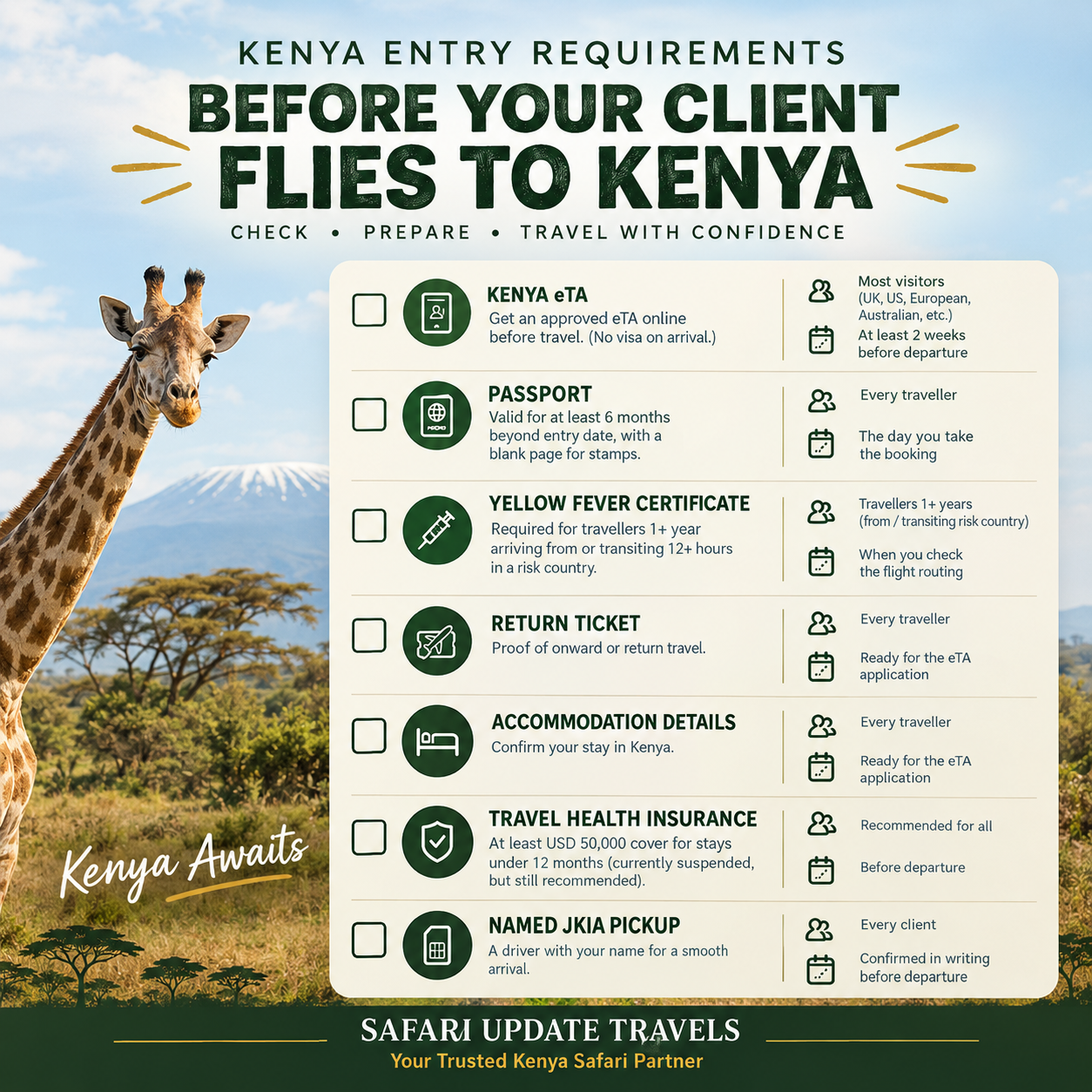
The core Kenya entry requirements in 2026 are short. Clients need an approved Kenya eTA obtained online before travel. They need a passport valid for at least six months beyond the date of entry, with a blank page for stamps. Depending on their travel history, they may also need a yellow fever vaccination certificate.
Kenya no longer issues visas on arrival for most visitors. It moved to the Kenya electronic travel authorization system in January 2024, so the eTA is the single most important document to secure early. Citizens of East African Community states and most other African countries are exempt, but that does not help your UK, US, European or Australian clients.
In practice, a client meets the standard requirements to fly into JKIA if they hold an approved eTA, a valid passport, proof of onward or return travel and their accommodation details. Everything else on this Kenya travel documents checklist is about making arrival smooth rather than about whether they can enter. Always confirm the current rules on the official Kenya eTA portal and health guidance when you book. Fees, exemptions and health rules change from time to time.
One new rule needs watching.
In July 2026 Kenya gazetted a requirement for visitors staying under 12 months to hold travel health insurance with at least USD 50,000 of cover. Proof is meant to be uploaded with the eTA application.
In August 2026 the High Court suspended enforcement pending a hearing, so it is not being applied today. Advise clients to carry cover at that level anyway. Check the position before each departure.
Item | Who needs it | When to sort it |
|---|---|---|
Kenya eTA | Most visitors, including UK, US, European and Australian passport holders | At least two weeks before departure |
Passport with six months validity and a blank page | Every traveller | The day you take the booking |
Yellow fever certificate | Travellers aged one and over arriving from, or transiting 12+ hours in, a risk country | When you check the flight routing |
Return ticket and accommodation details | Every traveller | Ready for the eTA application |
Travel health insurance | Recommended for all; the USD 50,000 rule is suspended by the court | Before departure |
Named JKIA pickup | Every client | Confirmed in writing before departure |
Our Kenya and Tanzania visa requirements page covers the same basics in a format you can share with clients.
The Kenya eTA: What Agents Must Know
The Kenya eTA, or Kenya electronic travel authorization, replaced the traditional visa for most visitors. It is the step most likely to trip up a client if you do not guide them. It is applied for entirely online before travel and linked to the client's passport. It must be approved before boarding, because airlines check for it when clients check in.
Apply only through the official government portal at etakenya.go.ke. This matters. Third party sites charge inflated fees. Applications through unofficial channels can also be delayed or denied, which is exactly the kind of avoidable problem that lands back on your desk.
The standard eTA costs USD 30 per person and allows a single entry. Standard processing takes up to three working days, with most approvals arriving within 24 to 72 hours. There is no official priority processing lane for standard travellers. The most effective thing you can do is ensure your application is submitted correctly and completely, which reduces the chance of it being held for manual review.
The practical rule to give every client: apply for the eTA at least two weeks before departure, using the official site. Have a clear passport scan, a photo plus flight and accommodation details to hand. Advise clients to save and print the approval and carry it with their passport. For where the eTA sits among the other costs a client pays directly, see our guide on how to price a Kenya safari for your clients.
Expert Insight: We ask agents to have clients apply for the eTA on a weekday morning rather than late on a Friday. Approvals that land over a weekend can leave a nervous traveller without confirmation right before departure. Applying early in the week means any query is resolved during business hours.
Passport Validity and the Kenya Yellow Fever Requirement
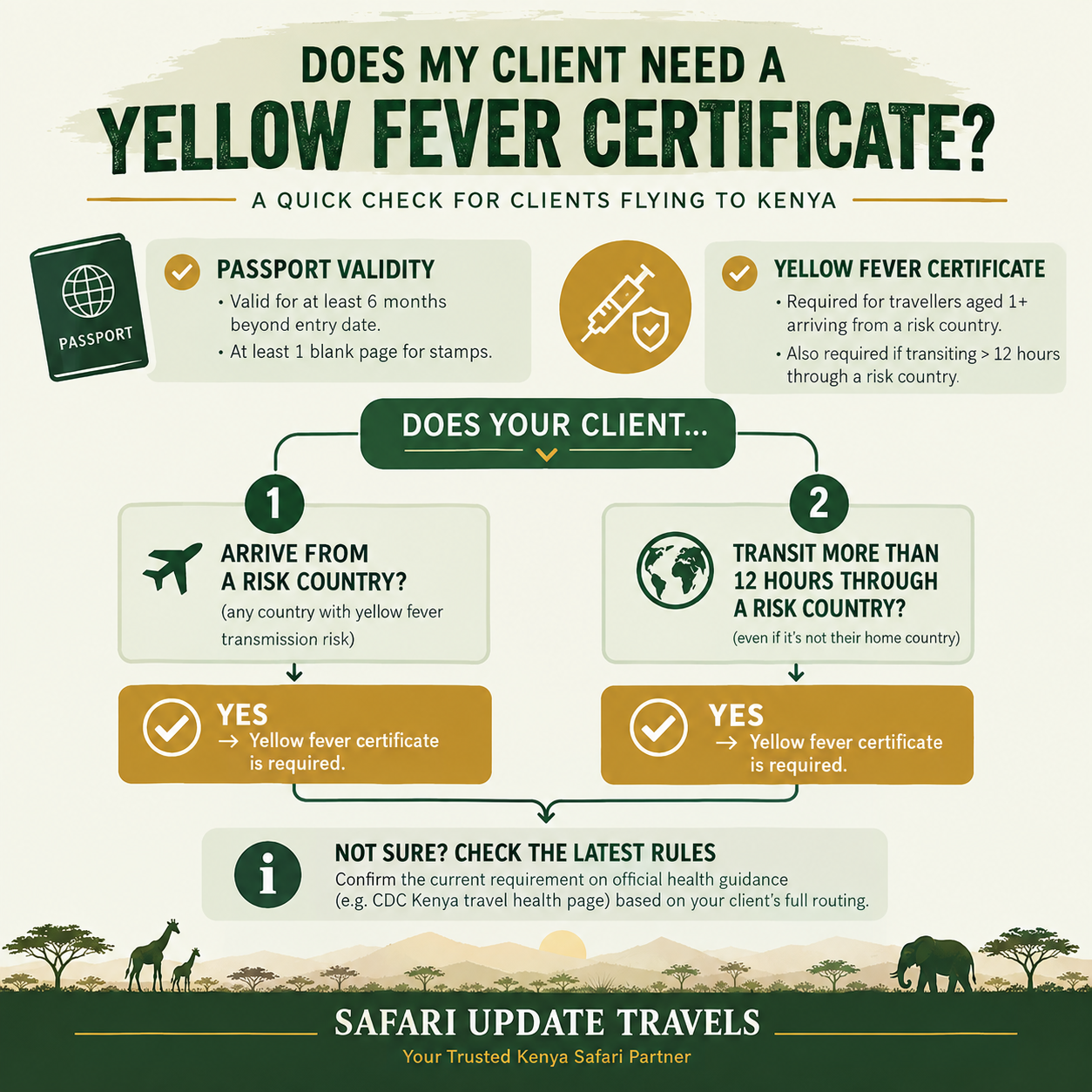
Passport validity is the requirement agents most often check too late. Kenya expects a passport valid for at least six months beyond the entry date, with at least one blank page for stamps. Check this the moment you take the booking. Renewing a passport can take weeks and is far easier to solve months out than days out.
The Kenya yellow fever requirement causes the most confusion. A yellow fever vaccination certificate is required for travellers aged one year and over who arrive from a country with a risk of yellow fever transmission. It also applies to travellers who have transited for more than 12 hours through an airport in a risk country. That can include connections through certain African and South American hubs.
Whether your client needs it depends on their full routing, so check their flight path, not just their home country. Confirm the current rule on official health guidance, such as the CDC's Kenya travel health page, at the time of booking.
Beyond the mandatory rules, advise clients to see a travel health clinic well ahead of a Kenya safari. They should ask about routine and recommended vaccines, including malaria advice for safari areas. This is client health advice, not an entry requirement. But a good agent raises it, because a client who falls ill remembers whether you prepared them.
The JKIA Arrival Process: What Happens on Landing
Reassuring clients about the JKIA arrival process is as valuable as the paperwork, because first time visitors often arrive anxious. Jomo Kenyatta International Airport in Nairobi is Kenya's main international gateway and is well used to international travellers. With an approved eTA and a valid passport, the process is immigration, baggage and out to the arrivals hall. Then it is either a road transfer or a light aircraft flight from Wilson Airport to the Masai Mara.
Give every client two reassurances. First, language is rarely a barrier. English is widely spoken across Kenya, including at the airport and in the tourism industry, so clients will be understood.
Second, getting online is easy. Local SIM cards from providers such as Safaricom are sold at the airport. A data SIM makes transfers, ride hailing and staying in touch simple from the moment clients land. Advise them to have their passport ready, as it is needed to register a SIM.
The most important arrival advice is about transfers. Tell clients exactly who is meeting them and how. The arrivals hall has many drivers offering rides. A client who does not know their pickup plan is open to confusion and overcharging.
This is precisely where a Kenya ground handler earns its place. Explain to clients that a named representative will be holding a sign for them.
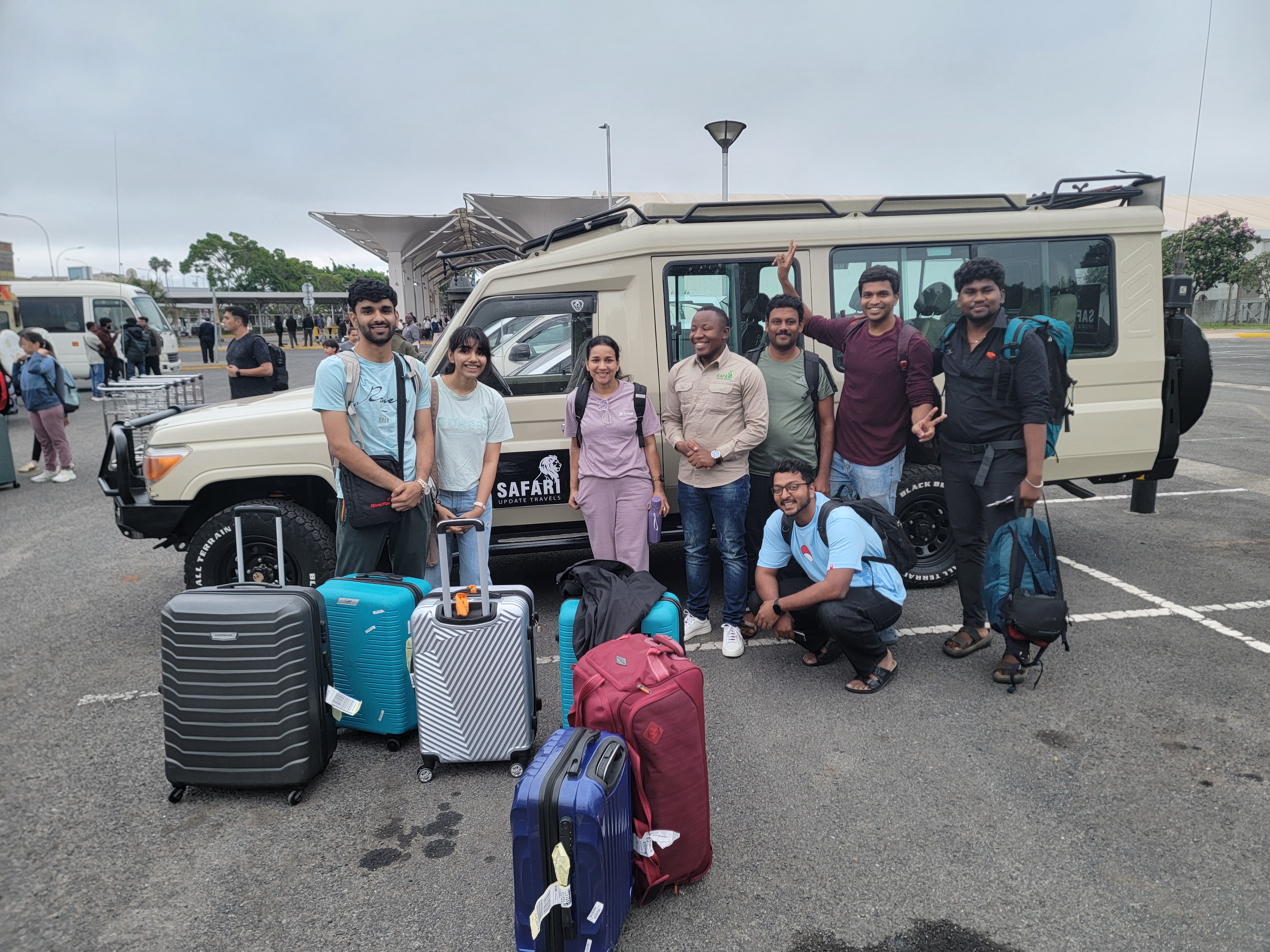
Expert Insight: The biggest arrival problem we see is clients who were never told who is collecting them. When Safari Update Travels handles the ground operation, a known representative meets the client by name at JKIA. That removes the one moment where a first timer feels most exposed. Confirm the meet and greet details in writing before departure.

Practical Briefing Points Before Departure
A few items that are not legal requirements round out a professional client briefing and prevent avoidable friction. These sit alongside the Kenya entry requirements rather than replacing them. Each one saves a call later.
Advise clients to carry proof of onward or return travel and their accommodation or itinerary details, as these can be requested. Recommend full travel insurance that includes medical cover and, ideally, medical evacuation, given that safari areas are remote.
Suggest they carry some US dollars in small, newer notes for tips and small costs, alongside a card. Many places also accept mobile and card payments. Finally, remind them that Kenya uses UK style three pin plugs, so travellers from the US and Europe need an adapter. Our first safari packing guide is a handy link to pass on with your briefing.
For how this briefing connects to the wider booking, from first enquiry through to the final documents you send, see how a Kenya safari booking works from enquiry to invoice.
Common Mistakes That Catch Travellers Out
Most problems with the Kenya entry requirements come from a short list of avoidable errors. Knowing them lets you head them off in your briefing.
The most common is leaving the eTA too late, then panicking when approval has not arrived the day before travel. The second is using an unofficial eTA website and either overpaying or having the application rejected. The third is a passport with under six months validity or no blank pages, found too close to departure to fix.
The fourth is judging yellow fever rules on nationality rather than checking the actual flight routing. The fifth is arriving without knowing who is meeting them at JKIA.
Every one of these is solved by an agent who briefs early and clearly on the Kenya entry requirements. It also helps to work with a ground handler that confirms the arrival plan in writing. The Kenya entry requirements are not the obstacle; poor briefing is.
Frequently Asked Questions
Do African and East African clients need a Kenya eTA?
Most do not, because Kenya entry requirements differ by nationality. Citizens of East African Community states, such as Tanzania, Uganda and Rwanda, are exempt and can stay up to six months. Since 2025 most other African nationals are also exempt for shorter stays, with Somalia and Libya the main exceptions. Check the client's exact passport on the eTA portal's eligibility page before you brief them.
Can a travel agent apply for the Kenya eTA on a client's behalf?
Yes. The official portal allows someone to apply for others, as long as the traveller's details are correct and you state that you are applying on their behalf. Every traveller needs their own eTA, including children. There is also a group option for families. Check each passport number and name against the scan, because a mismatch is a common cause of delay.
Does the Kenya eTA cover a trip into Tanzania and back?
The Kenya eTA stays valid for coming back into Kenya after a visit to an East African partner state such as Tanzania. So a client flying home through Nairobi does not need a second one. Tanzania still needs its own visa. The East Africa Tourist Visa does not cover it. Our Kenya vs Tanzania safari guide covers the paperwork for combined trips.
Do clients need a yellow fever certificate when flying on from Kenya?
Often, yes. Kenya is on the list of countries with yellow fever risk, so Tanzania and Zanzibar can ask travellers arriving from Kenya for proof. This is the side of the Kenya yellow fever requirement that catches clients out, because it bites on the onward leg rather than on arrival in Nairobi. Sources differ on short airport transits, so treat the certificate as essential for any onward trip.
What if a client's eTA is still pending close to departure?
Clients can check the status on the portal with the reference number from their confirmation email. If time is short, apply immediately and follow up with official support. If an application is refused, the client cannot travel to Kenya until it is resolved. The portal lists support contacts for help. This is why we advise applying two weeks ahead.
Do repeat clients need a new Kenya electronic travel authorization every trip?
The standard eTA allows one entry, so a new trip normally means a new application. Kenya also offers a one year multiple entry eTA at USD 300. US citizens can get a five year multiple entry eTA at USD 185. For clients who visit often, these can save time, so confirm current options on the portal before you advise.
Make Kenya Entry Requirements Part of Every Briefing
The Kenya entry requirements reward preparation and punish last minute scrambles. Build this Kenya travel documents checklist into your standard client briefing for every Kenya safari you sell. Secure the eTA early on the official site and verify the passport the day you book.
Check yellow fever against the routing and confirm exactly who meets the client at JKIA. Do that consistently and your clients arrive relaxed. That is the first impression that makes them book with you again. For anything this checklist does not cover, our FAQs page and trade team can help.
Let Safari Update Travels handle the ground operation and confirm your clients' JKIA arrival in writing. Register as a trade partner or email partner@safariupdatestravel.com.
Written by Linsel Ajode, Senior Safari Specialist at Safari Update Travels. Safari Update Travels is a Kenya based, TRA registered safari operator and ground handler, serving international travel agents and tour operators since 2016 and rated 4.8 stars on TripAdvisor, Trustpilot and SafariBookings. Learn more about our team or get in touch with our trade desk.