How to Price a Kenya Safari for Your Clients
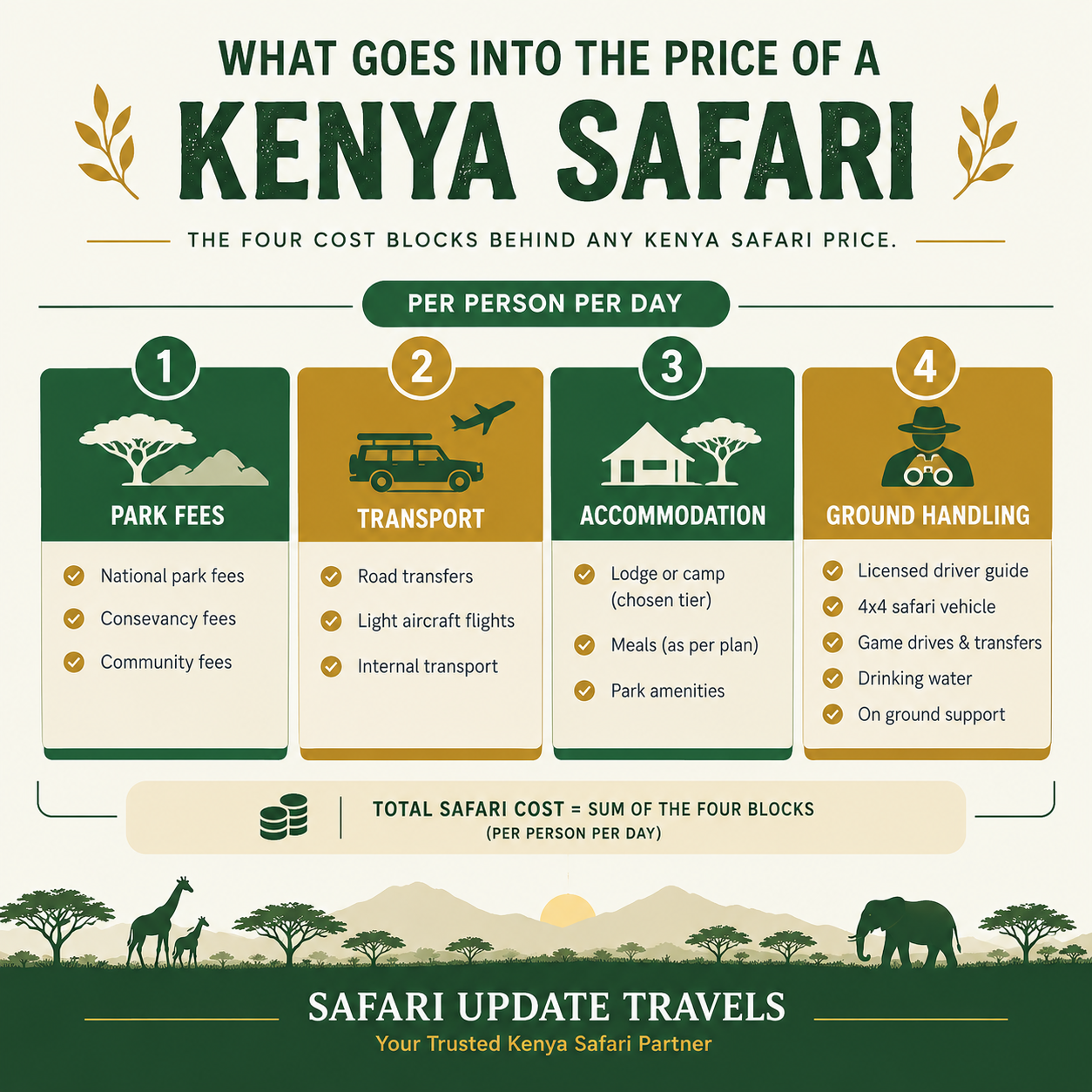
To price a Kenya safari for your clients accurately, you need to understand four cost blocks that move independently: park and conservancy fees, internal transport, accommodation tier and the ground handling services that hold it all together. Get those four right and you can quote a Kenya safari in minutes instead of days, defend your price when a client pushes back and still protect your margin. Get them wrong and you either lose the booking to a cheaper competitor or win it and lose money on the operations.
This guide is written for travel agents and tour operators who sell Kenya but do not run the ground operation themselves. It walks through exactly what goes into the price of a Kenya safari in 2027, where the numbers come from, the mistakes that quietly erode margin and how a ground handler builds a quote so you can sanity check any figure you receive. By the end you will be able to price a Kenya safari with confidence, whether it is a three night add on or a two week honeymoon. Keep this page open as your Kenya safari cost breakdown whenever you build a client facing quote.
Key Takeaways
● A Kenya safari is priced per person per day, not per trip. Budget trips run roughly USD 150 to 350 per person per day, mid-range USD 350 to 650 and luxury USD 650 to 1,500 or more, all inclusive of the bush days. Verify current figures against your ground handler's rate card before quoting.
● Park fees are the least flexible cost and the most seasonal. The Masai Mara non-resident fee is USD 100 per adult per day from January to June 2027 and USD 200 per day from July to December 2027, which alone can swing a quote by hundreds of dollars. Confirm current rates with the reserve authority.
● Accommodation tier is the biggest lever you control. Moving a client down one lodge tier often saves more than cutting a whole activity, without hurting the experience much.
● Internal flights versus road transfers change both price and client satisfaction. Flying is not always more expensive once you count a lost game viewing day on the road.
● Net rates protect your margin. Booking a Kenya safari through a ground handler on net rates lets you apply your own markup rather than reselling a fixed retail price. This is the core net rates for travel agents advantage: it keeps pricing control in your hands, not the operator's.
● Always separate what is included from what is not. International flights, visas, tips and drinks sit outside most quotes and cause the biggest disputes when missed. Confirm what is included in a safari package in writing, before you present a figure to a client.
How Do You Price a Kenya Safari for a Client?
You price a Kenya safari by building it up per person per day across four cost blocks, then adding your markup. The four blocks are park and conservancy fees, internal transport (road transfers and light aircraft flights), accommodation on the chosen tier and ground handling services (a licensed driver guide, a 4x4 safari vehicle, game drives, transfers, drinking water and on ground support). Add international flights and personal extras separately, because clients treat those as their own cost.
A useful shortcut: once you know the accommodation tier and the parks, most reputable ground handlers can give you a firm net rate per person per day. For a mid-range Kenya safari in 2027, a working planning figure is around USD 350 to 650 per person per day for the bush portion, before your markup and before international flights. Verify against a live quote; figures move with season and party size. Once you know the average safari cost per person per day for the tier and parks involved, applying your own markup takes minutes, not days.
Cost Block 1: Park and Conservancy Fees
Park fees are set by public authorities, are non-negotiable and are usually charged per person per 24 hours, so they scale directly with the number of nights in each park. They are the part of a Kenya safari price you cannot discount, which makes them the first thing to get right in a quote. The 24-hour cycle applies to Kenya Wildlife Service (KWS) parks such as Amboseli, Lake Nakuru and Tsavo. The Masai Mara works differently: it is managed by Narok County, not KWS, and issues a ticket valid for a fixed 12-hour window rather than a rolling 24-hour period. That distinction matters enough for pricing that it gets its own section below.
Kenya's premium parks, Amboseli and Lake Nakuru, charge non-resident adults in the region of USD 90 per day in 2027, with children paying a reduced rate. Tsavo East and Tsavo West are lower at around USD 80 per adult per day and combination tickets exist for linked parks such as Amboseli and Tsavo West. Confirm the current Kenya Wildlife Service tariff before quoting, as tiers were modernised recently and payment is now digital through eCitizen or KWS Pay rather than cash at the gate. The verified non-resident combination rate is approximately USD 150 per adult for Tsavo West and Amboseli together, and approximately USD 215 per adult for Tsavo East, Tsavo West and Amboseli combined. Always reconfirm both figures on KWS Pay at the time of booking, since combination pricing can be adjusted without much notice.
The Masai Mara sits in its own category and carries the single most important number in Kenya safari pricing. In 2027 the non-resident adult reserve fee is USD 100 per day from 1 January to 30 June, then USD 200 per day from 1 July to 31 December, reflecting peak migration demand. That seasonal jump means the same Mara itinerary can cost a client several hundred dollars more in August than in March, purely on fees. Confirm current Masai Mara rates with the managing authority. Unlike the KWS parks above, a Masai Mara entry ticket is valid for a fixed 12-hour window, normally 06:00 to 18:00, rather than a full 24 hours from the time of entry. A client who exits the gate after this window on a departure day can be charged for an additional day, so build a buffer into any Masai Mara itinerary rather than cutting it close. These Masai Mara park fees 2027 figures come from the Narok County Government, which manages the reserve independently of KWS, so always reconfirm them separately from the KWS parks in the same trip.
Private conservancies bordering the Mara, such as Mara North and Naboisho, charge a separate conservancy fee, typically USD 80 to 130 per adult per night, which is usually bundled into the lodge rate rather than billed separately. Conservancies limit vehicle numbers and allow off-road driving and night drives, which is why experienced agents often position them as the premium alternative to the main reserve. When you compare a conservancy option with a reserve option, make sure you are comparing like with like, because the conservancy fee is often already inside the nightly rate. The same principle, a conservancy fee bundled into the nightly rate rather than billed at a public gate, also applies to private sanctuaries such as Ol Pejeta in Laikipia, so always ask a ground handler to break out fees separately when comparing two properties.
Expert Insight: When we quote a Mara itinerary that straddles 1 July, we split the fee calculation at the date rather than applying one flat rate, because a client arriving 29 June and staying four nights pays two different daily rates. Agents who miss this under quote the peak nights and absorb the difference.
Cost Block 2: Internal Transport
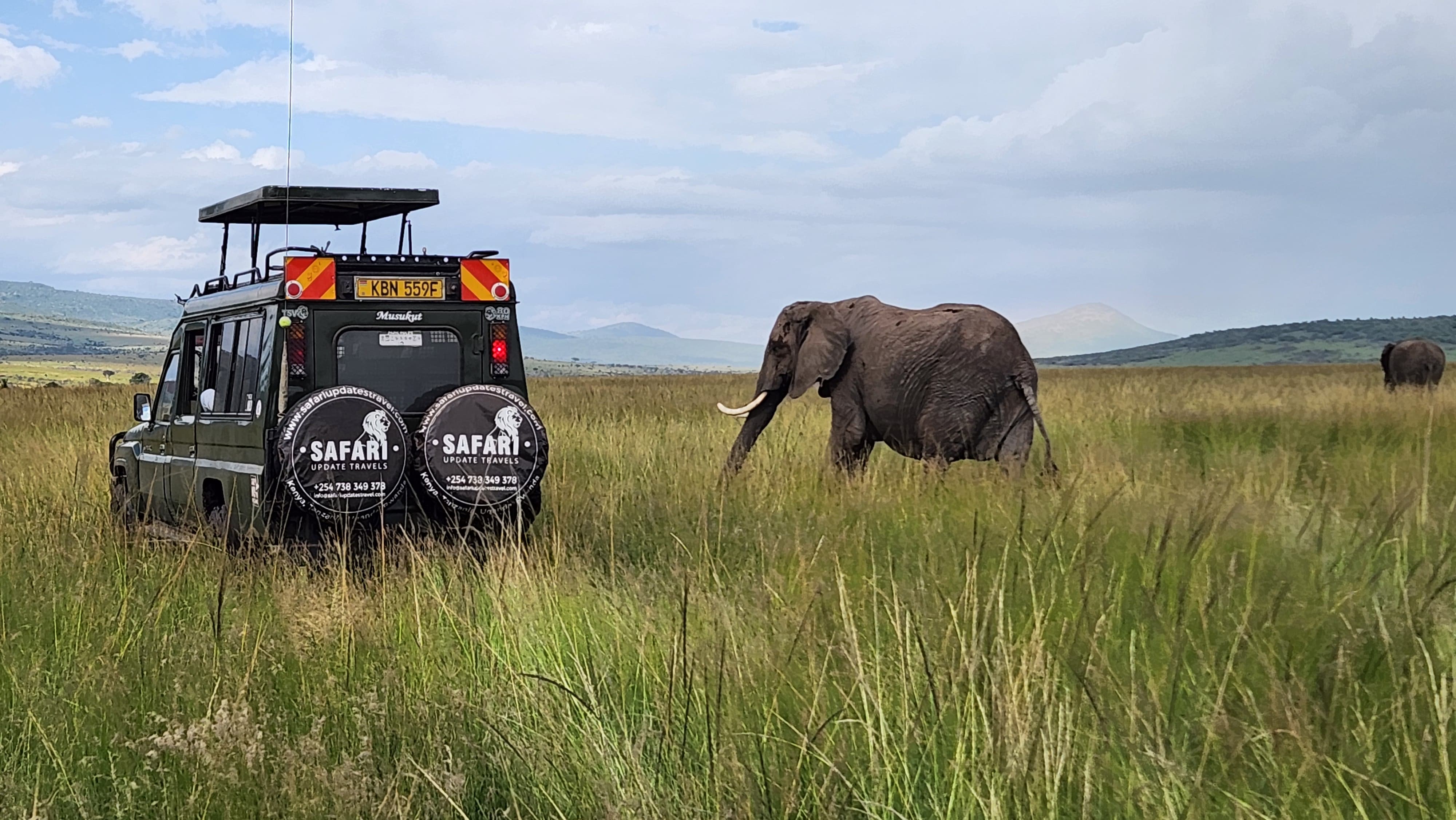
Transport inside Kenya is the block where agents most often trade price against client comfort. There are two models: overland road transfers in a 4x4 safari vehicle and light aircraft flights between airstrips and most itineraries mix the two.
Road transfers are cheaper on paper and keep the same driver guide and vehicle throughout, which many first time clients prefer for continuity. The trade off is time: Nairobi to the Masai Mara is roughly five to six hours on mixed roads and moving between distant parks such as Amboseli and the Mara can eat most of a day. That lost day is a hidden cost, because the client still pays for accommodation and fees but sees less wildlife.
Flights cost more per leg but buy back game viewing time and spare older clients long, rough drives. A practical rule when you price a Kenya safari: for any itinerary linking two or more distant parks, or any client over 60 or with back problems, price the flight option first and present the road option as the saving, not the default. This frames the more comfortable choice as the standard and protects you from complaints about brutal transfer days.
Expert Insight: On multi park routings we schedule inter-camp flights rather than long road transfers for clients who have paid for a premium experience, because a full day in a vehicle on a transfer road undoes the value of an expensive lodge. The flight usually costs a booking less in goodwill than the road day costs in complaints.
Cost Block 3: Accommodation Tier
Accommodation is the largest single lever you control when you price a Kenya safari and it is where you should look first when a client asks you to bring the number down. Kenya's lodging splits broadly into three tiers and moving between them changes the total far more than trimming an activity or a night.
Budget properties are simple tented camps and small lodges, comfortable but basic and suit younger travellers and first safaris. Mid-range covers well run tented camps and lodges with good guiding and food, which is where most international clients are happiest. Luxury spans premium tented camps and boutique lodges in prime locations and private conservancies, where much of the price reflects exclusivity and location rather than just the room.
The table below gives working per person per day planning ranges for a Kenya safari in 2027, all inclusive of the bush days (accommodation, park fees, driver guide, game drives and transfers) but before international flights and your markup. Treat these as sanity check ranges, not quotes and always confirm against a live net rate from your ground handler.
Tier | Typical property style | Planning range (per person per day, 2027) | Best for |
|---|---|---|---|
Budget | Basic tented camps, small lodges | USD 150 to 350 | Younger travellers, first safaris, tight budgets |
Mid-range | Quality tented camps and lodges | USD 350 to 650 | Most international clients, families, couples |
Luxury | Premium camps, conservancy lodges | USD 650 to 1,500+ | Honeymoons, special occasions, repeat safari clients |
[Ranges are indicative market figures for 2027; verify each quote against your ground handler's current net rates.]
For real worked examples at each tier and circuit, see our sample 5-day Masai Mara, Lake Naivasha and Lake Nakuru safari, 7-day Samburu, Ol Pejeta, Lake Nakuru and Maasai Mara safari and 9-day Amboseli, Tsavo and Mombasa/Diani safari, or browse the full range of Kenya safari packages.
When a client pushes back on price, drop one tier before you cut nights or parks. A client will remember a shortened trip far longer than a slightly simpler tent and cutting a park usually means wasting the fixed transport cost of getting there. Read our companion guide on how a booking works from enquiry to invoice for how these choices flow into a firm quote.
Cost Block 4: Ground handling Services and Your Margin
The fourth block is the ground operation itself: a licensed driver guide, a maintained 4x4 safari vehicle, game drives, park and airport transfers, drinking water and the on ground support that fixes problems while your client is in the field. This is what a Kenya ground handler, or destination management company, actually sells you and it is the part that determines whether the trip runs smoothly or falls apart on day two.
This is also where net rates matter for your margin. When you book a Kenya safari through a ground handler on net rates, you receive a supplier level price and apply your own markup, keeping pricing control and the client relationship. That is very different from reselling a fixed retail package, where your margin is whatever the operator decides to leave you. This net rates for travel agents model is exactly what Safari Update Travels runs for its trade DMC partners. For how to choose that partner, see why your Kenya ground handler matters more than your itinerary.
Working with a single ground partner across all four blocks also removes the reconciliation headache of paying park authorities, camps, drivers and flight operators separately. You send one enquiry, receive one net quote, apply one markup and issue one invoice. Safari Update Travels builds quotes this way for agents and can return a costed Kenya safari itinerary quickly so you can respond to your client while the enquiry is still warm.
What Is Included and What Is Not
The fastest way to lose trust on a Kenya safari is a client discovering a cost they thought was covered. Spell out inclusions and exclusions in every quote, in writing, before the deposit.
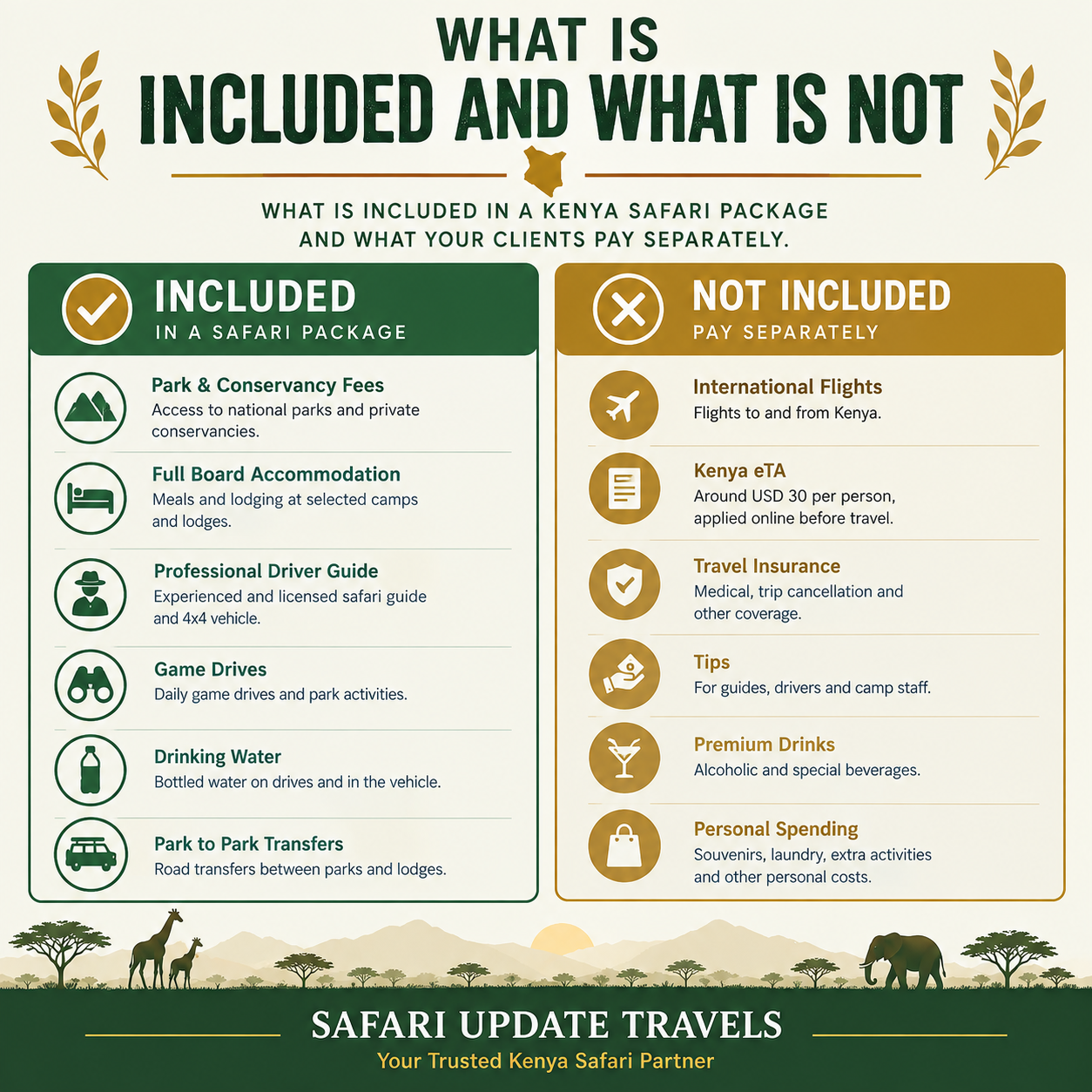
A Kenya safari package is normally all inclusive for the bush days, covering park and conservancy fees, full-board accommodation, a professional driver guide and game drives, drinking water on drives and transfers between parks. What is typically excluded: international flights to Kenya, the Kenya eTA (around USD 30 per person, applied online before travel), travel insurance, tips for guides and camp staff, premium drinks and personal spending. For the full pre departure list your clients need, see our Kenya entry requirements checklist. Put this what is included in a safari package breakdown in writing on every quote, before any deposit is requested.
Common Pricing Mistakes Agents Make
Even experienced agents lose margin on Kenya through a handful of repeatable errors. Knowing them is half the fix.
The first is quoting a flat daily rate across a date that crosses the Masai Mara high season boundary, which underprices the peak nights. The second is forgetting that park fees are per 24 hours, so a late morning arrival and an early departure can still count as two fee days. This mistake bites hardest at the Masai Mara, where the ticket window is only 12 hours rather than 24, so an early morning arrival followed by a late afternoon departure two days later can trigger a third day's fee rather than two. The third is comparing a conservancy option against a reserve option without noticing the conservancy fee is already inside the nightly rate, which makes the conservancy look wrongly expensive. The fourth is presenting the cheapest transport by default and then fielding complaints about a lost day on the road.
The fix for all four is the same: build the quote per person per day, block by block and lean on a ground handler who prices Kenya every day and catches these before they reach your client.
Frequently Asked Questions
How much does a Kenya safari cost per person per day in 2027?
As a planning guide, budget Kenya safaris run about USD 150 to 350 per person per day, mid-range about USD 350 to 650 and luxury about USD 650 to 1,500 or more, all inclusive of the bush days but excluding international flights. These are market ranges, not quotes and the final figure depends on season, party size and parks. Always confirm against a live net rate before you quote a client. Use this benchmark every time you price a Kenya safari for a new client, then confirm the exact figure against a live quote.
Why are Masai Mara park fees so much higher than other parks?
The Masai Mara is Kenya's flagship reserve and applies demand based pricing, with the non-resident adult fee rising from USD 100 per day in the first half of 2027 to USD 200 per day from July to December to reflect peak migration season. Other parks such as Tsavo sit around USD 80 and premium parks such as Amboseli around USD 90. This seasonal structure is why the same itinerary costs noticeably more in August than in March. These Masai Mara park fees 2027 also run on a 12-hour ticket window rather than the 24-hour cycle used at Amboseli, Lake Nakuru and Tsavo, so double check gate times on any itinerary that spans several days.
What are net rates and how do they help travel agents?
Net rates are supplier level prices that a ground handler gives to trade partners, allowing the agent to add their own markup rather than reselling a fixed retail price. They give you pricing control, protect your margin and let you package Kenya inside a larger multi country itinerary, for example alongside Tanzania as part of a combined Kenya and Tanzania safari. Most reputable Kenya ground handlers offer net rates to registered agents with no minimum volume.
Should I quote road transfers or internal flights?
Quote flights first for any itinerary linking distant parks or for older or less mobile clients and present road transfers as the cheaper alternative. Road transfers keep the same guide and vehicle and cost less, but long transfer days reduce game viewing time that the client is still paying for. The right answer depends on the routing and the client, which is why it belongs in a conversation, not a default setting.
What is usually excluded from a Kenya safari price?
Most quotes exclude international flights, the Kenya eTA (around USD 30 per person), travel insurance, tips, premium drinks and personal spending. Park fees, accommodation, the driver guide, game drives and inter park transfers are normally included for the bush days. This is why every reputable ground handler puts what is included in a safari package in writing, line by line, rather than leaving it to a verbal assurance. Always list inclusions and exclusions in writing before taking a deposit to avoid disputes.
How quickly can a ground handler turn around a Kenya safari quote?
A ground handler that prices Kenya daily can usually return a costed itinerary within a working day once they have the dates, party size, tier and parks. Fast quote turnaround matters because clients often contact several agents at once and the first solid, well explained quote frequently wins the booking. Safari Update Travels prioritizes quick turnaround for trade partners for this reason. Ready to test that turnaround? Request a live quote or send your next enquiry to see how fast a complete brief comes back.
For more agent facing answers, browse our full FAQs page, or book a consultation with our trade team for an itinerary specific walkthrough.
Price Kenya with Confidence
Once you price a Kenya safari block by block, the destination stops being intimidating and becomes one of the most profitable, repeatable lines in your Africa portfolio. Park fees anchor the quote, accommodation tier gives you the biggest lever, transport balances cost against comfort and a reliable ground handler on net rates protects your margin and your reputation. Price a Kenya safari this way and you can answer any client challenge with a clear, defensible breakdown. Bookmark this Kenya safari cost breakdown, keep our Kenya destinations guide close for park by park detail, and use both together as the starting point for every Kenya quote you build from here on.
Register as a trade partner and request net Kenya safari rates. Email partner@safariupdatestravel.com to get started.
Quotes issued by Safari Update Travels are governed by our standard terms and conditions; see our privacy policy for how enquiry data is handled.
Written by Linsel Ajode, Senior Safari Specialist at Safari Update Travels. Safari Update Travels is a Kenya-based, TRA-registered safari operator and ground handler, serving international travel agents and tour operators since 2016 and rated 4.8 stars on TripAdvisor, Trustpilot and SafariBookings. Learn more about our team or get in touch with our trade desk.